 SRI
LANKA 21/03/2005
SRI
LANKA 21/03/2005

|
|
SRI LANKA A SEVERED leg hangs from the rafters of what was once a family home. In the eerie silence, it twists and turns in the breeze, the flesh rotting in the baking heat.
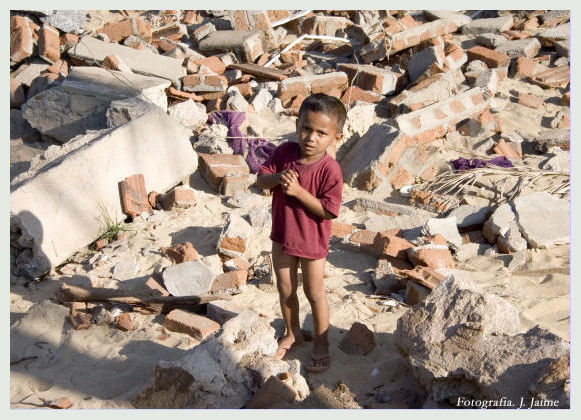
Three months on from the disaster, all across Sri Lanka the tragic victims are trying to rebuild their lives. Wherever you go, there is is an image of survival that is humbling as we witness these broken people trying to get through each day. In the immediate aftermath there was chaos and confusion as victims numbed by the loss of so many loved ones tried to make sense of the tragedy. It is only now, with the passing of time that the pain of grief is beginning to hit them. We found these refugees in a makeshift camp close to the village of Pasikudah on the road to Trincomalee, where the tidal wave has ripped bridges and roads making the distribution of aid even more difficult. Just a few hundred metres from the clutch of flimsy thatched shacks is the rubble that used to be their homes. The entire community was reliant on fishing and they have lost absolutely everything in the disaster. Villagers pick among the rubble, looking for anything they can salvage, carrying it back to the camp. The ghosts are everywhere. A plastic photo album lies among the scattered debris and when we pick it up it is a stark reminder of just how vital life was in this strong community. The image of three smiling girls is barely visible through the snapshot soaked in tsunami water. Like most of the people in the village, they are missing. In the camp, smoke swirls from open fires as the fishermen that are left sit mending nets in the hope that they can work again. One fisherman told us: “We have nothing here. We lost 200 of our people and everyone is still trying to understand why this happened. It’s terrible. “But all we can do now is live from day to day. We have had hardly any help so we are trying to survive by ourselves. But every day is a hardship.”
All the time, they want to tell us about their children and loved ones who the will never see again. One woman lost her daughter and son-in-law. Through tears she clutches their picture tells us: “I cry for them every day and night. Everyone is crying because in every house someone has lost a member of their family. We are still finding it hard to believe. Even when I look at their pictures I can’t accept that I will never see them again.” There are stories like that across the land. And incredible tales of survival, like the 10-year-old boy we met in a camp in Kalmunai in the Ampara district. Janathanan was in Sunday school when the tsunami swept away 38 of his little friends. He survived by climbing to the top of a tree. Later that afternoon he found his mother and father dead on a hospital trolley. He is alone now and plays in the camp in his shabby pyjama top and shorts. A family friend who is looking after him says he doesn’t mention his parents – but he talks about them in his sleep. You have to ask where is the help for these people? Even given the logistics of getting aid to remote areas and the massive scale of the tragedy, wherever we went in two weeks across the tsunami ravaged areas, little seems to have moved on. Just days ago, Scots actor David Hayman voiced his concern as he wept while visiting a refugee camp south of Colombo. Much as some immediate relief has got through, including the setting up of toilets, tented villages and school facilities, there are still tens of thousands of refugees who have nothing. We travelled from Galle in the south to Trincomalee in the north and everywhere we went, refugees are queuing at government offices for help.
We met a German businessman and grandfather who used to come here with his family, and has spent a small fortune kitting out schoolchildren. At 71, he travelled the country by himself to deliver the aid by hand so that he could see it was going to the right place. Others send mosquito nets as malaria is rife because of the conditions in the aftermath of the tsunami. But it is homes, not mosquito nets that these people need. The Lions Club international have pledged to build 4,000 houses and are raising money in their local business clubs worldwide. They have already started work in some of the worst areas now that they have made a deal with the government for the land. But the process of rebuilding is going to be long and arduous. The latest death toll for Sri Lanka is almost 31,000. Nearly half a million people are homeless. In the Ampara district alone almost 10,000 people died. In Putovil, one of the worst areas, schools and homes were wiped out. In another village just a few miles from Kalmunai, nothing whatsoever remains of one village, and the people are angry and frustrated. One father told us: “We keep hearing news that so much money has been raised and we will all be given new homes, but we have seen nothing. “We go to the town every day and are given rice and some other things, but we are still coming back to our tents. Nothing seems to be moving at all. Where has all the money gone? When are we going to see it?” Perhaps soon someone will give them some answers. Anna Smith. |
||
| Sent on the 21/03/ 2005 | ||
 As
you must already know,
we are preparing the documentation to be sent to the Clubs, which will
include a series of articles written by a famous Scottish journalist,
that went on the trip with Jesús to Sri Lanka. We will be sending
it in English and of course translated into Spanish. So you can use it
in both languages. All this information will be sent to the president
of your Club, it will be sending all on a disk and also printed, so that
way you can makes copies and give it out to the press of your area. You
must think that you must give things already done to the press, if it's
no work for them, they will find a place in their newspaper. I insist
that all this information is very valuable and interesting, it would be
a great shame no to use it to get money, or just simply to promote our
association in our community. Never before the Spanish Lions have done
such a great international project, even our foundation (LCIF), has never
in its history ever challenged itself in such an enormous reconstruction
project, 5.000.000 Dollars. We can say very proudly that we are going
to build many houses, more the better. That will depend on us!
As
you must already know,
we are preparing the documentation to be sent to the Clubs, which will
include a series of articles written by a famous Scottish journalist,
that went on the trip with Jesús to Sri Lanka. We will be sending
it in English and of course translated into Spanish. So you can use it
in both languages. All this information will be sent to the president
of your Club, it will be sending all on a disk and also printed, so that
way you can makes copies and give it out to the press of your area. You
must think that you must give things already done to the press, if it's
no work for them, they will find a place in their newspaper. I insist
that all this information is very valuable and interesting, it would be
a great shame no to use it to get money, or just simply to promote our
association in our community. Never before the Spanish Lions have done
such a great international project, even our foundation (LCIF), has never
in its history ever challenged itself in such an enormous reconstruction
project, 5.000.000 Dollars. We can say very proudly that we are going
to build many houses, more the better. That will depend on us!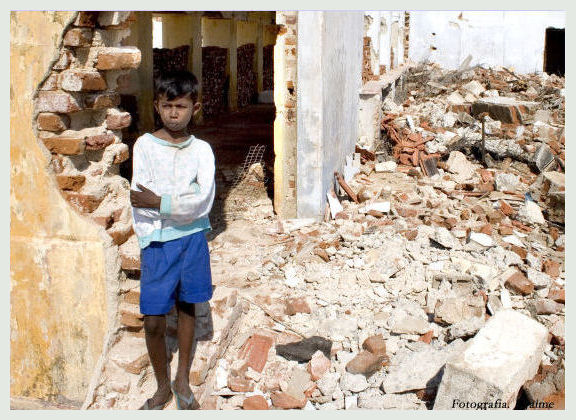 No-one
in this forgotten village, high up Sri Lanka’s devastated east coast
even knows who it belongs to. They are too busy trying to survive among
the ruins where 200 souls perished in the tsunami that all but swallowed
up the entire coastline of this tropical paradise.
No-one
in this forgotten village, high up Sri Lanka’s devastated east coast
even knows who it belongs to. They are too busy trying to survive among
the ruins where 200 souls perished in the tsunami that all but swallowed
up the entire coastline of this tropical paradise.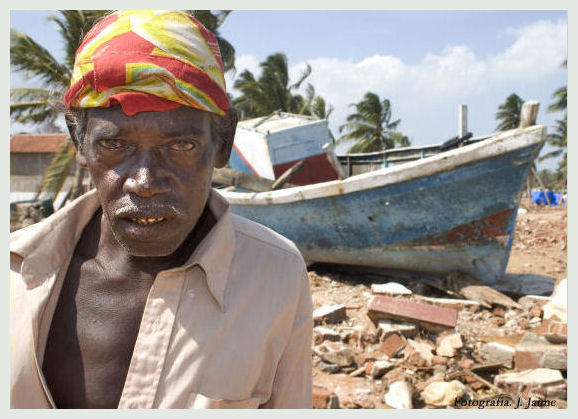 Even
in their sorrow, the villagers try to make do with what they have. They
have nothing but the clothes they are standing in. They wash their children
in buckets of water and pick nits from their hair to try and keep at bay
the lice that are inevitable in this level of squalor. They are proud
and dignified people who are not used to living like this, and they do
their best to keep their homes clean, but it is impossible in the heat
and lack of hygiene.
Even
in their sorrow, the villagers try to make do with what they have. They
have nothing but the clothes they are standing in. They wash their children
in buckets of water and pick nits from their hair to try and keep at bay
the lice that are inevitable in this level of squalor. They are proud
and dignified people who are not used to living like this, and they do
their best to keep their homes clean, but it is impossible in the heat
and lack of hygiene. 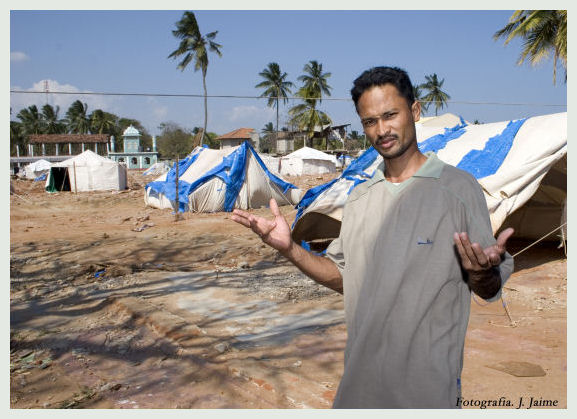 They
are given emergency cash to buy immediate food. But each family is only
given 5,000 rupees to rebuild their lives. Sri Lanka is teeming with Non
Government Organisations who are doing their best to help with the rebuilding
projects. And there are dozens of private organisations and business people,
some of them tourists who used to come ere, who are spending their own
cash to dedicate help to one village or school.
They
are given emergency cash to buy immediate food. But each family is only
given 5,000 rupees to rebuild their lives. Sri Lanka is teeming with Non
Government Organisations who are doing their best to help with the rebuilding
projects. And there are dozens of private organisations and business people,
some of them tourists who used to come ere, who are spending their own
cash to dedicate help to one village or school.